
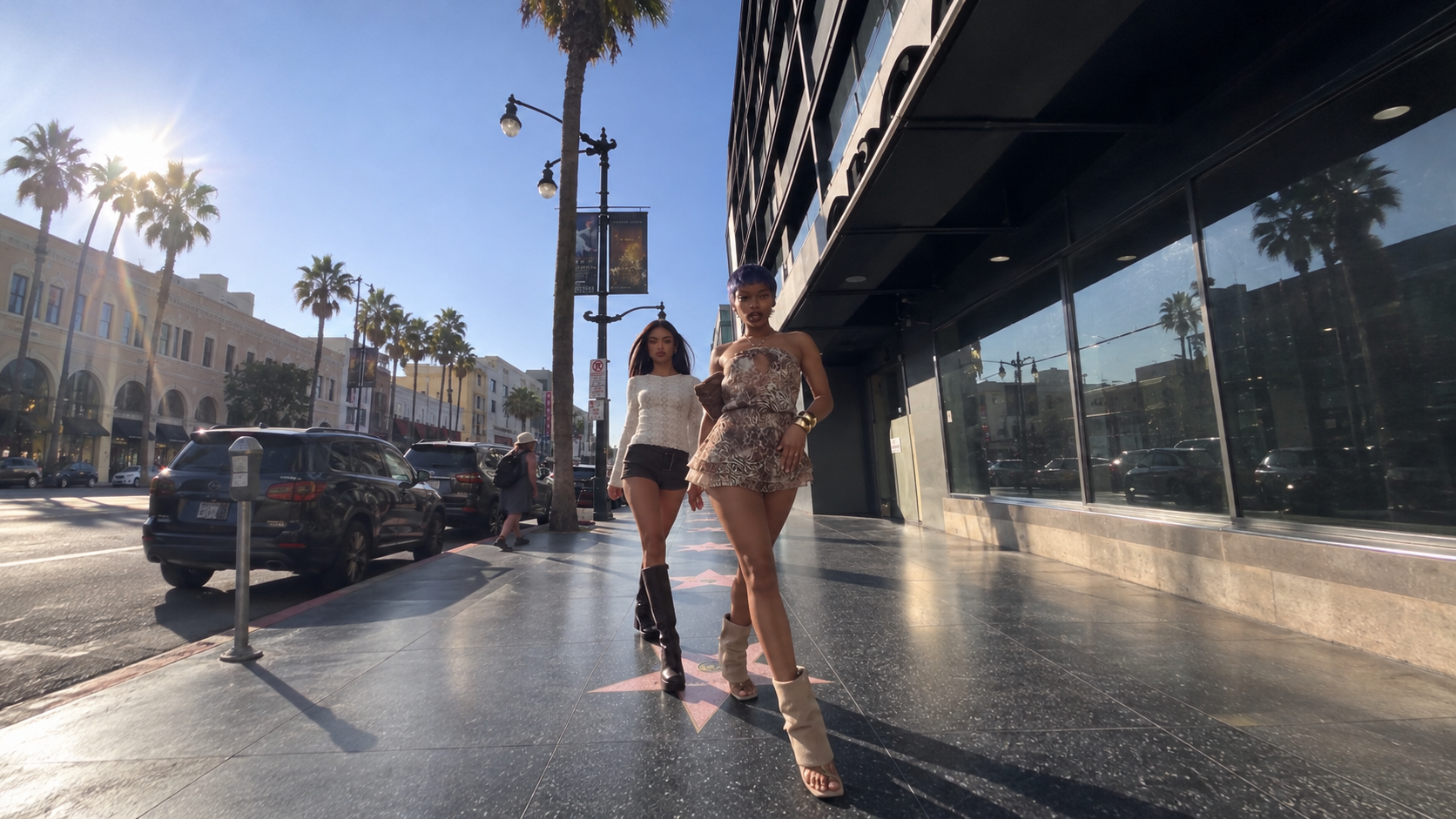
Fashion brands usually start looking for AI content because their teams need more creative than traditional production can supply.
Social teams need a steady flow of posts. Ecommerce teams need consistent imagery across more products. Marketing teams need campaign variations, short-form video, and content before a traditional photoshoot is practical.
Some platforms turn sketches into product concepts. Some place garments on AI models. Others generate campaign images or short videos. General creative tools can help a team explore ideas, but they still require someone inside the brand to operate the software, review the output, and decide how the content fits into the marketing strategy.
LookSky belongs in a different category. We are an AI fashion marketing agency, not a software tool. Our team builds and manages dedicated AI influencers, creates campaign and social content, checks garment accuracy, publishes through dedicated accounts, and helps brands reach new audiences.
This guide compares ten well-known AI tools, platforms, and services that fashion brands may consider, based on the business problem each one is designed to solve.
The useful question is not which company is best at everything. It is which one solves the problem your brand actually has.
A tool can generate an asset. It does not create brand discovery by itself.
Brand discovery requires more than an image.
A brand needs to decide who it wants to reach, what that audience cares about, which products to introduce, how to frame the story, where to distribute the content, and what to do when a creative concept starts working.
Most AI platforms help with one part of that process. They may generate product photography, design variations, campaign concepts, or video clips. The brand still needs an internal team or outside agency to turn those assets into a marketing program.
This distinction should shape the buying decision.
- If the problem is product development, choose a product-development platform.
- If the problem is ecommerce imagery, choose an on-model or product-photography platform.
- If the problem is video production, choose a video-generation platform.
- If the problem is marketing and brand discovery, the brand needs more than a generator.
How we evaluated the options
We reviewed each company’s current public product information as of November 2026. We considered:
- The company’s primary use case
- Whether it is fashion-specific
- Image and video capabilities
- Product and garment inputs
- Model consistency
- Human creative involvement
- Marketing strategy and distribution
- Whether the brand or a vendor operates the workflow
- The type of fashion team the solution is designed to serve
Methodology note: We reviewed public product information but did not test the same garment across every platform. Request demonstrations with your own products before comparing fidelity, quality, or speed.
1. LookSky: Best for fashion teams that need social media content
Type: AI fashion marketing agency
Best suited for: Fashion brands that want LookSky to build the virtual influencer, create social-native content, operate the account, and grow a new audience
LookSky builds and operates dedicated virtual influencer social media programs for fashion brands. Social media content generation is a central part of the service, but the work does not end when the image or video is finished. Unlike the self-service products in this guide, LookSky is an agency.
Our work starts with the audience the brand wants to reach. We develop the AI model’s identity, location, personality, and style around that customer. We then create recurring posts, product stories, captions, cinematic ads, and short-form videos designed for the way people watch and share content on social platforms.
The videos are social-native, not conventional campaign footage resized for a feed. We build the hook, pacing, music, format, styling, and story for Instagram, TikTok, and YouTube Shorts from the beginning.
A LookSky social-native fashion video created around recurring virtual influencers.
LookSky also launches and manages dedicated social accounts. This gives a brand another discovery channel without requiring every experiment to appear on its primary feed.
Our human team manages the full process:
- Audience and account strategy
- AI influencer development
- Creative concepts and scripts
- Product selection and styling
- Image and video production
- Garment and character review
- Client approvals
- Publishing and account management
- Performance analysis
This is the central difference between LookSky and the software platforms in this guide. The brand does not receive another workflow to operate. It receives an agency team responsible for generating social content and using that content to support marketing, audience growth, and brand discovery.
LookSky is designed for brands that need a recurring stream of social-native content tied to a larger marketing and brand-discovery program.
2. Raspberry AI: Best for connecting fashion design to commercial assets
Type: Enterprise fashion platform
Best suited for: Enterprise design, product, merchandising, and marketing teams that want one system from concept through commerce
Raspberry AI is a fashion-specific platform that connects trend research, design, technical design, merchandising, wholesale, marketing, and ecommerce.
Its strongest distinction is its reach across the product lifecycle. Teams can develop mood boards, technical designs, product visualizations, assortments, lookbooks, campaign creative, product pages, and digital commerce assets in one system.
Raspberry can produce campaign and marketing assets, but its public offering centers on helping a brand's own teams move from concept to commerce. It does not position itself as an agency that launches and operates dedicated influencer accounts or assumes responsibility for audience growth.
Choose Raspberry when the central problem spans product creation and the commercial assets around it. Choose an agency when the central problem is operating social channels and turning content into audience growth.
3. Kive: Best for an AI creative workspace
Type: AI visual workspace
Best suited for: Consumer-brand teams that want to generate, organize, and collaborate on visual assets
Kive combines product photography, asset organization, collaboration, and AI-assisted creative production in a shared workspace.
Kive supports fashion and apparel, but it is not limited to fashion. Its broader customer base includes beauty, accessories, home, food, and other consumer categories.
Its Creative Agent can brainstorm directions, generate branded visuals in bulk, create short video ads, and work with products and recurring characters stored in the workspace. The feature is currently described by Kive as a beta rolling out to eligible accounts.
Kive helps an internal team produce and manage creative. The brand still owns the audience strategy, channel operation, publishing, and performance decisions.
4. Botika: Best for on-model ecommerce photography at scale
Type: AI fashion-content platform with self-service and managed options
Best suited for: Fashion brands that need on-model images across a large product catalog
Botika turns flat lays, hanger images, ghost-mannequin shots, and existing product photos into on-model fashion imagery.
The platform focuses heavily on ecommerce and campaign production. Its current site advertises more than 150 AI models, bulk processing, consistent collection imagery, editorial scenes, and image-to-video output.
Botika also offers managed launch support and custom models for qualifying accounts. Its self-service product relies on Botika's model and background libraries rather than letting every user create a proprietary model.
Its core value remains asset production. Botika can help a brand create the images needed for product pages, campaigns, ads, and social channels. The brand still needs a marketing strategy and distribution plan to turn those assets into discovery.
5. FASHN: Best for self-service fashion ecommerce creation
Type: Fashion-specific AI platform and API
Best suited for: Ecommerce teams and developers that want hands-on fashion imagery, video, virtual try-on, and API access
FASHN describes itself as an AI agent for fashion ecommerce. It offers product-to-model imagery, virtual try-on, model creation and swapping, editing, packshots, reusable models, and short video.
Its fashion-specific workflows distinguish it from a general generator. A user can begin with a product photo, model image, library asset, or written idea and refine the result inside a shared workspace.
FASHN also provides API access and now advertises market monitoring and AI-visibility features. This makes it relevant to brands as well as retailers, marketplaces, and technology teams integrating generation into an existing system.
FASHN is a strong option when the brand wants software it can operate directly. Its own site advises users to compare generated images with the real product because AI can still change small details. The internal team also remains responsible for publishing and the broader marketing program.
6. Browzwear: Best for enterprise digital product creation
Type: Enterprise 3D fashion and digital-twin platform
Best suited for: Apparel companies connecting 3D design, fit, development, collaboration, and production
Browzwear operates further upstream than most content-generation tools.
VStitcher supports true-to-life 3D garments, fabric simulation, fit validation, tech packs, and virtual samples. Stylezone gives teams a cloud workspace for reviewing, changing, merchandising, and approving collections.
This makes Browzwear particularly relevant when the main problem is digital product creation and reducing physical samples, not running a social content program.
Browzwear is not primarily a social media or influencer-marketing solution. It may help produce the digital product assets a marketing team needs, but the brand still requires a strategy for content, storytelling, audience growth, and distribution.
7. Adobe Firefly: Best for established Adobe creative teams
Type: General enterprise creative platform
Best suited for: Brands and agencies already working in Photoshop, Illustrator, Premiere Pro, and Adobe Express
Adobe Firefly generates and edits images, video, audio, and vectors. It combines Adobe's own models with selected third-party models inside one creative environment.
Its advantage is not fashion specialization. It is integration with the professional tools many creative teams already use. Designers can move between generation and detailed editing without rebuilding the workflow around a separate fashion platform.
Adobe describes its own Firefly models as commercially safe and attaches Content Credentials to Firefly output. Terms can differ for third-party models available inside Firefly, so brands should review the model used for each asset.
Firefly can help a creative team develop concepts and produce assets. It does not select the brand’s target audience, build an influencer identity, manage a social account, or create brand discovery without a marketing and distribution strategy around the output.
8. Photoroom: Best for ecommerce visual operations at scale
Type: AI product-photography and editing platform
Best suited for: Ecommerce teams that need consistent product imagery, catalog automation, and short product videos
Photoroom is widely used for background removal, product staging, image cleanup, resizing, and ecommerce photography.
Its current fashion offering includes AI fashion models, ghost mannequins, flat lays, virtual try-on, product staging, batch processing, catalog tools, APIs, and video ads for major social platforms.
Photoroom is particularly practical when the problem is operational: high SKU volume, inconsistent backgrounds, limited retouching capacity, or the need to prepare and distribute catalog assets quickly.
It is not a replacement for a fashion-marketing strategy. Better product images may support conversion and brand consistency, but the brand still needs ideas, audience targeting, distribution, and content programming to create discovery.
9. Runway: Best for advanced AI video and creative production
Type: General AI video and creative platform
Best suited for: Creative teams, filmmakers, agencies, and brands producing or adapting video at scale
Runway offers a cloud creative suite for generating and editing video, images, and audio. Its current products include character performance, creative agents, workflows, APIs, and tools for producing and publishing ad variations to Meta, Google, and TikTok.
Runway gives experienced teams considerable room to produce cinematic movement, effects, short films, campaign concepts, and performance variations.
It is not built specifically around garment accuracy or fashion merchandising. A team using Runway for fashion content still needs strong reference images, careful prompting, post-production, and human review. It also needs a broader marketing plan that determines what the video should communicate and where it should live.
Runway now covers more of the production and ad-variation workflow than the earlier draft suggested. The brand or its agency still defines the audience, offer, channel strategy, and long-term social program.
10. Midjourney: Best for visual exploration and image-led video
Type: General image and video generator
Best suited for: Mood boards, campaign concepts, visual directions, and early-stage creative exploration
Midjourney is a widely recognized image and video platform. Creative teams use it to explore visual worlds, lighting, locations, styling directions, and campaign concepts. Its video tool animates a starting image into a short clip.
For fashion brands, its strongest use may be early in the creative process. A team can investigate several directions before committing to a shoot or production plan.
Midjourney is not a fashion product-production system. A compelling image or clip does not guarantee an accurate garment, consistent model, or usable product representation. The brand must review every output carefully and move product-specific work into a more controlled process.
It can help answer, “What could this campaign look like?” It does not answer, “Who should this campaign reach, how should we distribute it, and what should we do when it performs?”
Which AI fashion-content solution should your brand choose?
Start with the problem, not the feature list.
| If your brand needs... | Consider... |
|---|---|
| Ongoing social media content for marketing and brand discovery | LookSky |
| A system spanning fashion concept through commercial assets | Raspberry AI |
| 3D garment creation, fit, and virtual sampling | Browzwear |
| An AI creative workspace for an internal team | Kive |
| On-model ecommerce photography at scale | Botika or FASHN |
| Ecommerce catalog imagery and visual operations | Photoroom |
| Enterprise creative controls inside an Adobe workflow | Adobe Firefly |
| Advanced AI video and creative production | Runway |
| Visual exploration and image-led video | Midjourney |
That does not make the companies interchangeable.
The most important difference is who remains responsible after the image is generated.
With a self-service platform, the brand usually operates the tool, develops the strategy, reviews the output, manages approvals, publishes the content, and evaluates performance.
With LookSky, our agency manages those steps with the brand.
What fashion brands should ask before buying an AI solution
Before selecting a platform, tool, or agency, ask:
- What problem are we trying to solve?
- Who will operate the workflow and review garment accuracy?
- Can it maintain a consistent model across images and video?
- Who owns the AI model and finished assets?
- Who develops, publishes, and distributes the content?
- How will the work support audience growth or sales?
The answers will reveal whether the brand needs software, production support, or a marketing partner.
LookSky is an agency, not another tool
LookSky works with fashion brands that need more than isolated asset generation.
Our agency builds dedicated AI influencers and produces social-native images and videos around them. Our human team checks garments, manages approvals, publishes content, and studies performance.
A second LookSky example showing how a brand-owned virtual influencer can support a distinct character, setting, and fashion story.
The objective is not simply to create more AI content. It is to create content made for social platforms, then use it to help the brand reach new audiences and become easier to discover.
Book a LookSky demo to discuss the audience, creative strategy, and content program your brand needs.
Build a virtual influencer your brand owns.
LookSky develops the character, creates social-native content, manages publishing and uses performance data to grow brand discovery over time.
Book a LookSky demo