
You have something worth selling, and maybe a sign that people would pay. The next question stops most people cold: where do you find the first person who will actually buy, when almost nobody knows your name yet?
Good news: the first customer almost never comes from a big following. It comes from one real problem, a handful who have it, and a conversation before any pitch. This is a guide to doing that—without an audience, ads, or a website.
You don’t need an audience to find your first customer
An audience reaches strangers at scale. Your first customer isn’t a strangers-at-scale problem; it’s a find-one-right-person problem. You don’t need a thousand followers. You need ten good conversations with people who have the problem you solve.
This matters even more when you sell expertise instead of a product on a shelf. People don’t hand a hard problem to someone they just discovered. They hand it to someone they trust—or someone a trusted person vouches for.
Start with a problem people already admit they have
Before you look for people, get sharp on the problem. The strongest first customers come from problems people already say out loud. Look for three signals:
- Repeated questions. The thing people keep asking you—or asking in public—that you happen to know cold.
- Urgent complaints. Frustrations people voice with heat because the problem is costing them right now.
- Paid workarounds. Places where people already spend money, hire a freelancer, or duct-tape a tool to cope.
If you’ve already worked through what you can sell from what you already know and how to know if people will pay before you build a website, you already have a candidate problem.
Write down who the first buyer might be
Get concrete on paper before you reach out. A sentence or two is enough:
- Who they are. “A founder at a 20-person startup whose support is falling apart,” not “businesses.”
- The problem. In their words—the way they would complain about it.
- What they’ve tried. The workaround they use now, and why it isn’t enough.
This is a starting guess, not a life sentence. You’ll revise it after the first few conversations.
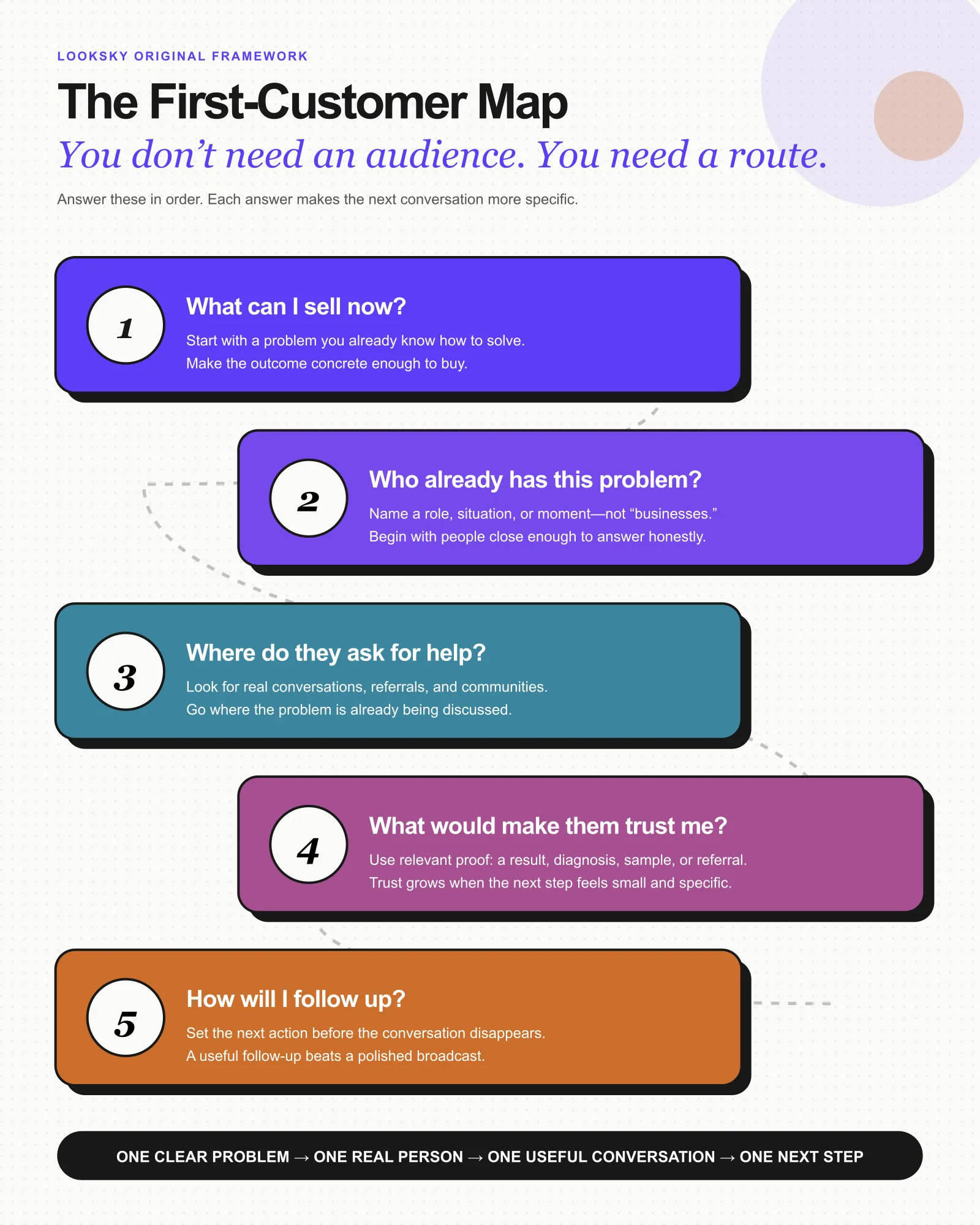
The First-Customer Map
Here’s the whole approach on one page. These five questions replace an audience:
Find about 20 people or places where the problem shows up
Use the seven source categories below to build a list of about 20 specific people or places. Start with the highest-advantage sources: they combine existing trust with the clearest evidence that the problem is real.
| Source | Why it works | Starting advantage / 4 |
|---|---|---|
| Old coworkers and weak ties | They know your work and can recognize the problem you solve. | Known work |
| Warm introductions | Someone you both trust lends you their credibility. | Borrowed trust |
| People who asked before | They have already signaled interest in the problem. | Prior interest |
| LinkedIn posts and comments | People are describing the exact pain in public now. | Public signal |
| Niche communities | People ask for help candidly. Read first; help second. | Public signal |
| Competitor reviews | Unhappy customers are actively looking for another way. | Active pain |
| Existing providers | A provider who is too big or expensive may refer work; treat them as a referral source, not a prospect. | Referral only |
🔥🔥🔥🔥 Trust + fit
🔥🔥🔥 Prior interest
🔥🔥 Visible need
🔥 Indirect path
½ Partial evidence
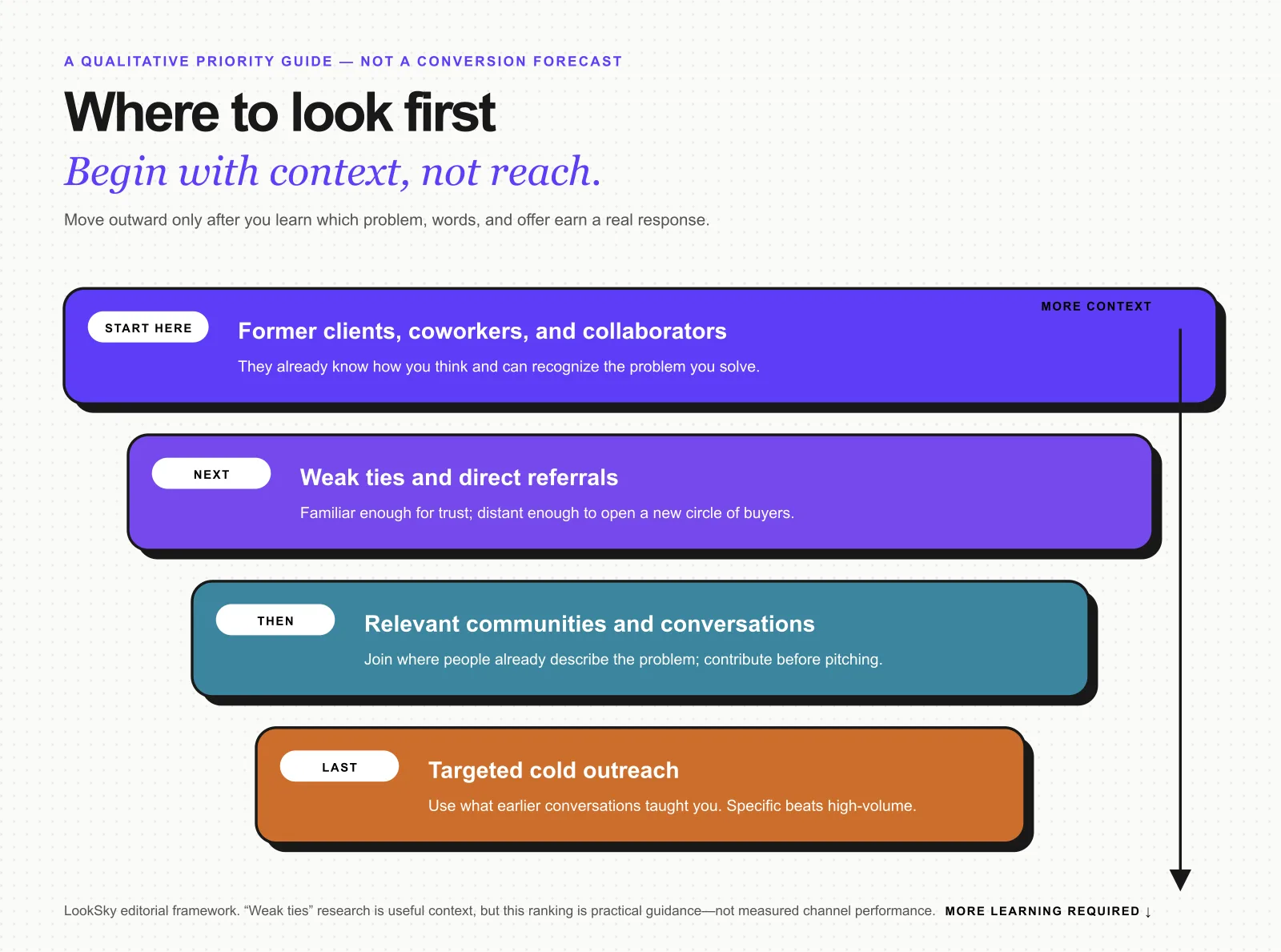
A 2022 Science study covering more than 20 million LinkedIn users found that moderately weak connections led to more job moves than close friends. The study measured jobs, not customers, so treat it as a strong hint—not proof—that people just outside your inner circle can open the next door.
Start conversations before you sell
Here’s where most people blow it: pitching in the first message. Don’t. The first goal is a conversation about the problem, not a sale. You’re learning and building trust at once.
A note to a weak tie or former coworker
“Hi [Name], it’s been a while. I’m digging into [problem] right now and talking to a few people who deal with it. You came to mind because of your work at [place]. Would you be up for a 15-minute call so I can hear how you handle it? Not selling anything—just learning.”
A note to someone describing the problem publicly
“Hi [Name], your post about [specific thing they said] matched what I keep hearing. I’m talking to people wrestling with this. Could I ask you two quick questions about how you’re handling it now?”
Both are specific, reference something real, and ask for something small. No mass copy-and-paste. No fake flattery.
- What happened? “Walk me through the last time this came up.”
- What did you try? “What are you doing now, and where does it fall short?”
- Why now? “What makes this worth solving now?”
- Listen for money. Do they already pay to cope—and roughly how much?
Make a simple first offer
When a conversation shows real pain you can fix, make a small, concrete offer in three parts:
“Based on what you described, I think I can [result] in [timeframe]. Want to start with [small first step] and see how it goes?”
Follow up without sounding pushy
Following up isn’t pestering when it’s useful. Give them a useful recap, answer the likely hesitation, and offer one specific next step—not “let me know.”
“Hi [Name], thinking about what you said on the timeline being tight. Here’s how I’d keep this small to start: [one line]. If that works, I can send a short plan by Friday. Fair?”
If they go quiet, one more note a week later is fine. Then leave the door open and move on.
A worked example
A former operations lead spent years fixing broken hiring inside fast-growing companies, with no audience and no website. She wrote down her buyer: a founder at a 30-to-60-person company whose hiring had become slow and chaotic.
She listed 18 people: seven old coworkers, four founders she’d met once, and a handful posting about hiring headaches. Five agreed to talk. Two became scoped, paid pilots. No funnel, no followers—just real conversations with people who already had the problem.
What to build once you know what buyers care about
Conversations come first. Only then do you know enough to build something worth building:
- A clear page that names the problem the way buyers said it.
- Content from real questions buyers asked before they trusted you.
- A way to capture interest from people who aren’t ready yet.
- A follow-up system so no conversation quietly dies.
This is where doing everything by hand breaks. A first customer becomes a second and a fifth, and the page, content, answers, and follow-up all have to work together.

SAM’S FIELD NOTE
Listen for the reason behind the purchase
“We were right about who they were—and only half right about why they bought.”
Before LookSky, I started Grae Cove with the same team that is building LookSky with me today. We knew who it was for: women who wanted a slower, more sustainable life. We built beautiful linen clothes for lounging, and that crowd showed up. On paper, we’d nailed our customer.
Then we actually talked to them. Customers kept telling us something we hadn’t put on the label: they were buying our linen to pack for vacation. Breathable, breezy, easy to wear somewhere warm.
That’s what a good customer conversation gives you that no plan can: not just whether people want what you make, but the reason they reach for it, in their words. Go in only to confirm what you already believe, and you’ll miss the vacation.
Frequently asked questions
How do I get my first customer without an audience?
Start with one specific problem and about 20 relevant people or places where that problem already appears. Prioritize former coworkers, professional acquaintances, and warm introductions. Ask for short learning conversations before offering anything. When someone describes an urgent problem you can solve, propose one small, paid next step. Ten relevant conversations are more useful than a thousand passive followers.
Where do I find people who might need what I sell?
Begin with people who already know your work: former coworkers, past clients, professional acquaintances, and warm introductions. Then look for the problem in LinkedIn posts, niche communities, competitor reviews, and questions people ask publicly. Choose people based on evidence of the problem—not demographic assumptions—and contribute something useful before requesting their time.
How do I ask someone for a first sales conversation?
Do not lead with a pitch. Send a short message that references something real about the person or their situation, explains the problem you are researching, and asks for 15 minutes to learn how they currently handle it. Keep the request small and specific. The purpose of the first conversation is understanding; an offer comes only after you hear meaningful pain.
Should my first customer come from friends or former coworkers?
Former coworkers and looser professional connections are often better starting points than close friends. They have seen how you work, but they also connect you to problems and networks beyond your immediate circle. Ask them for perspective or an introduction rather than emotional support. Close friends can help, but their encouragement is not reliable evidence that a market will pay.
How many people should I contact to find my first customer?
Start with approximately 20 carefully chosen people, ranked from warmest to coolest. That is enough to test whether the problem and buyer are specific without turning outreach into spam. Track replies, conversations, repeated language, urgency, and paid workarounds. If 20 relevant warm contacts produce no meaningful interest, revise the problem, buyer, or offer before increasing outreach volume.
How do I follow up without sounding pushy?
Make the follow-up useful. Briefly restate what the person said they need, address the hesitation that may be slowing the decision, and suggest one concrete next action with a reasonable date. Avoid messages that only say “checking in.” If there is no response, send one final helpful note about a week later, leave the door open, and move on.
Do I need a website before getting my first customer?
No. You can find and serve a first customer through direct conversations, referrals, a clear written offer, and a simple way to accept payment. Build the website after several buyer conversations so it reflects their language, questions, objections, and desired result. A website can then strengthen a validated offer; it should not substitute for learning whether the problem matters.
What should I charge my first customer?
Charge a real, clearly stated price tied to the result and scope, even if the first project is deliberately small. A paid pilot or paid working session provides stronger evidence than free work because the customer accepts an actual trade-off. Define the outcome, boundaries, timing, and next step in writing. Avoid vague discounts or unpaid work offered only for exposure.