
You have an idea for a business built on what you know. Before you spend a weekend on a website or a month on a funnel, answer a cheaper question: will anyone actually pay for this? Most people answer it the wrong way, by asking friends, posting the idea, and counting the "great idea" replies. Those answers feel like progress and prove almost nothing.
This is a guide to getting real evidence before you build. Not opinions or likes, but evidence you can act on, gathered in a week or two, without an audience or a finished product.
Why most "validation" is fake
The stakes aren't abstract. In CB Insights' analysis of startup post-mortems, the most common reason companies failed was building something with no real market need, cited in roughly a third to over 40 percent of cases depending on the dataset. In almost every case, the information needed to avoid it existed before anyone built anything. The founders just didn't ask, or asked in a way that produced flattering answers.
Here is what does not count as validation:
- Surveys and "would you use this?" questions. People are unreliable about hypothetical futures. A someday-yes predicts almost nothing.
- Compliments. "That's a great idea" is kindness, not a purchase.
- Likes, follows, and views. Attention is not intent. A viral post can sit on top of zero buyers.
- A free waitlist. An email costs nothing, so it proves nothing beyond curiosity. A waitlist with a deposit is a different story.
Rob Fitzpatrick's book The Mom Test names the trap: if you tell people your idea, they lie to spare your feelings, and they don't even know they're doing it. The fix is to stop asking about your idea and start asking about their life.
Start with the question that kills the idea fastest
Before you research anything, write down the one assumption that, if wrong, kills the whole thing. Usually it's that the customer you're picturing doesn't really have this problem, the problem isn't painful enough to pay to solve, or the price you need doesn't match what they'll pay. Validation is the work of testing that assumption as cheaply as possible. If you can only test one thing, test the one most likely to be fatal.
Where to find honest signal before you talk to anyone
Before your first conversation, look at where people already reveal their problems and spend money. Each source proves something specific, and something it cannot.
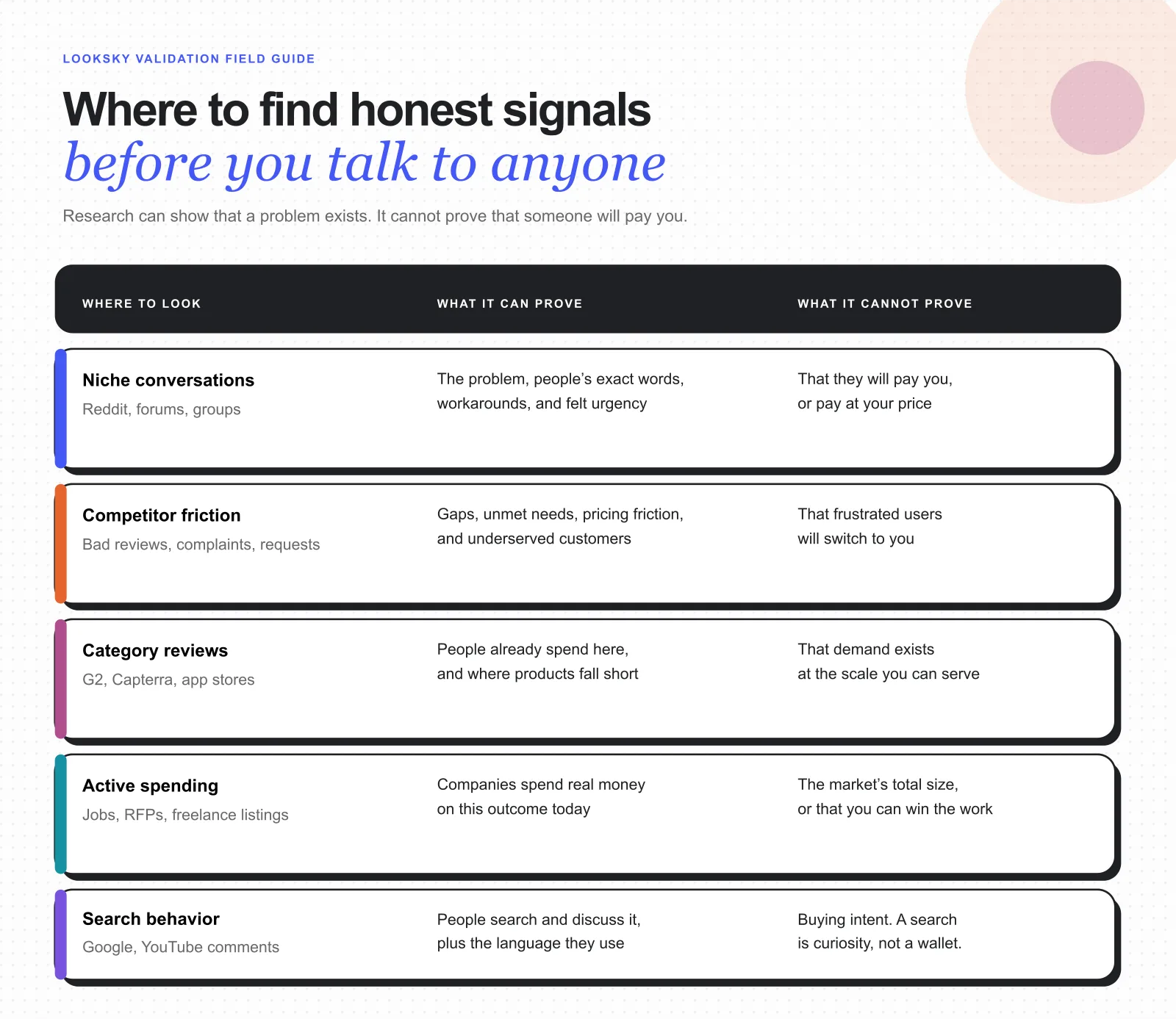
A rule to keep you honest: this research proves a problem is real, not that anyone will pay you to solve it. Treat it as a map, not a verdict, and don't let one loud thread stand in for a market.

RESEARCH, THEN VERIFY
Borrow the customer’s language
Use recurring phrases as hypotheses. Behavior still has to confirm them.
Talk to people the right way
Desk research tells you where to dig. Conversations tell you whether the pain is real and what it costs. The method that keeps them honest is the problem interview, sharpened by two ideas.
The first is the Mom Test. Don't pitch your idea. Ask about the person's actual life and past behavior. Instead of "would you use a service that does X," ask "walk me through the last time X came up. What did you try, and what did it cost you?" You want history, not hypotheticals, because history is the only thing people can't fake.
The second is the switch interview, from jobs-to-be-done research. When someone has recently changed how they solve a problem, reconstruct it: what triggered them to look, what they tried, what made them move, and what they paid. The moment of switching is where real demand lives, because that's when someone actually spent money.
If you can't get a handful of the right people to give you twenty minutes, that reluctance is itself a signal worth reading.

The strongest test is asking for money
None of that validates that someone will pay you. For that, you have to ask, before the product exists. The good news: you can deliver the first version by hand. It's the oldest trick in lean startup practice, and it still works:
- Concierge delivery. You do the whole thing manually and the customer knows it. Eric Ries's Lean Startup popularized it; the classic example is Food on the Table, whose founder planned meals by hand before building software.
- Wizard of Oz delivery. The customer thinks it's a finished product, but you're doing the work behind the curtain. Zappos tested demand by photographing shoes in local stores and shipping them by hand, with no inventory. Use it only when it's honest about what the customer receives.
- Paid diagnostic or paid pilot. Charge a real, if small, price for a scoped first engagement. Payment is the clearest signal there is.
- Refundable deposit, request to book, or preorder. Ask for a small commitment before you're ready to deliver. A deposit someone is willing to lose tells you far more than a free signup.
One firm ethical line: it's fine to test demand before you can deliver at scale, but never take real money for something you can't deliver. Smoke tests and "coming soon" pages are fine when transparent. Taking payment for a thing that cannot exist is not a test, it's a broken promise.
The Proof Ladder
Here's the framework to organize it. Every piece of evidence sits on a rung: the more it costs the other person to give, the more you should trust it.
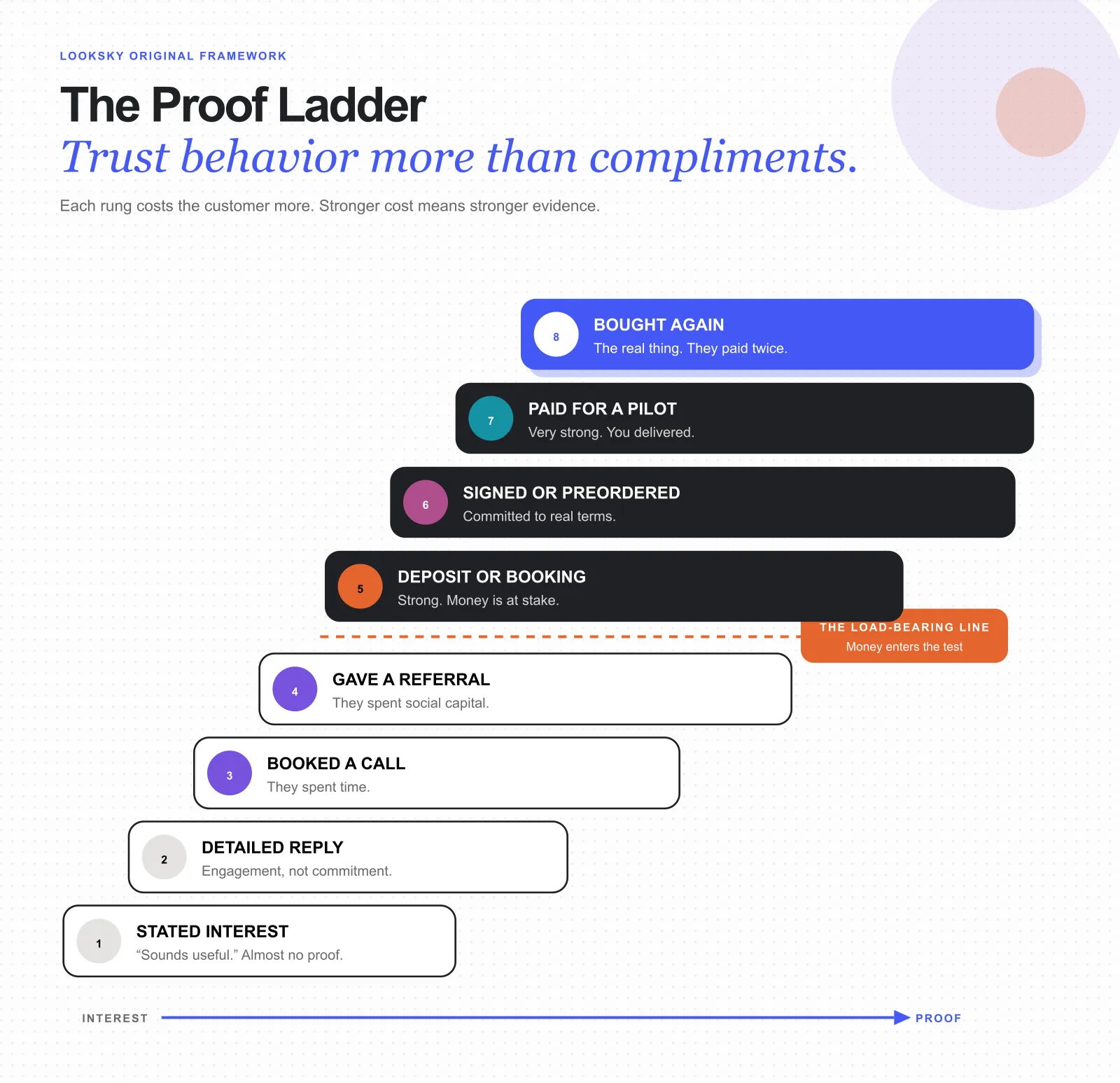
The line that matters sits between rungs 4 and 5: everything below is interest, everything above is behavior with a cost attached. You are validated not when people are enthusiastic, but when you reach at least a deposit, ideally a paid pilot. Repeat purchase is the only signal that proves the business, not just the idea.
A seven-day validation sprint
You can run a first pass in a week.
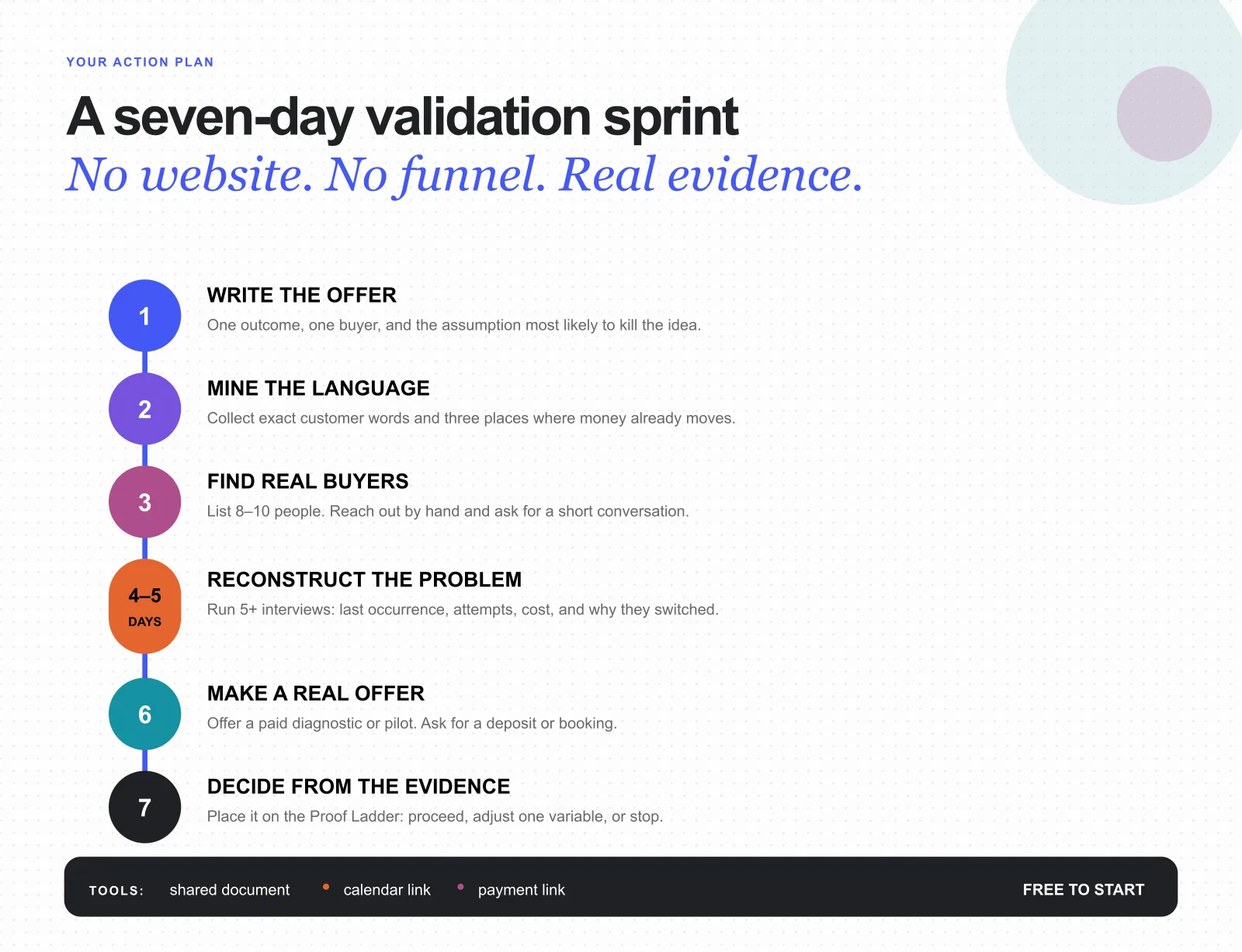
No website, no funnel. Free tools throughout: a shared doc, a calendar link, a payment link.
What changes after validation
Validation is not a finish line, and this is where most guides go wrong. Even after you've confirmed the customer, problem, offer, delivery model, and price, all of them keep moving. That's not failure. It's the normal shape of a business finding itself.
What tends to stay stable is the underlying human need, if you validated it honestly. People needed trust, or time back, or to look right at a moment that mattered. That core rarely changes.
What stays flexible is almost everything around it: which segment is your best customer, the occasion that brings them in, how you deliver, what you charge, the channel that drives growth. Expect all of these to shift.
The signals that justify changing direction are concrete. Buyers keep reshaping your offer toward a use you didn't intend. A different segment shows up with more urgency and less price resistance. Delivery breaks every time you try to do it your way. When you see these, follow the money and the pull. Keep the validated need; stay loose on the rest.

SAM’S FIELD NOTE
Sam's field note
Two businesses taught me the same lesson from opposite directions.
My co-founders had built what they describe as Asia's largest online dating platform. They say the core need was validated almost immediately: people wanted trust and real matches. But growth didn't truly take off until they added call centers with facilitated matchmaking. The need was right from the start; the delivery model that scaled it came later.
At 9Tailors, I got lucky the same way. We had product-market fit almost immediately, but I had the customer wrong. I assumed my main customer was a young professional who needed work clothes. The business ended up serving the wedding market. The demand was real on day one; the best customer, the occasion, and how we grew were all different from what I first pictured.
That's the part people miss. Early demand can be completely real while your best customer, occasion, service model, and growth engine are still wrong. Validation tells you the need exists. It does not hand you the final shape of the business. Keep the validated need, and watch who actually shows up with money.
Frequently asked questions
How do I validate a business idea without any audience?
You don't need an audience, just a handful of the right people. Find 8 to 10 who fit your target customer through your network or warm intros, then have real conversations and make a small paid offer. Behavior from ten fitting people beats applause from a thousand strangers.
Isn't a landing page or a waitlist enough to validate?
Not by itself. A landing page measures curiosity, and a free waitlist measures even less. Validation requires a cost signal: a deposit, a booking, or a payment. If your waitlist asks for a refundable deposit, now it counts.
How many customer interviews do I need?
Five to ten focused conversations with people who fit your buyer will surface the main patterns. Quality matters more than count. Ask about what actually happened in the past, not what they'd hypothetically do, and stop when new conversations stop surprising you.
What's the difference between people saying yes and real validation?
Saying yes is free. Real validation costs the other person something: time, a referral, a deposit, or a payment. Anything below a deposit is interest. A deposit or a paid pilot is evidence. A repeat purchase is proof.
Can I validate a business just by reading Reddit and competitor reviews?
No. That research is valuable for finding real problems, customer language, and gaps competitors leave open, but it only proves a problem exists somewhere, not that your customer will pay you. Use it to build a map, then test the map with conversations and a paid offer.
My idea was validated, so why are sales slow now?
Validation confirms the need is real. It doesn't lock in your best customer, price, or delivery model, and those usually shift as you learn. Slow sales often mean the need is right but one variable is off. Look at who buys most easily, and adjust toward them.