
You have real expertise. What you do not have is a clear answer to a smaller question: which part of it would someone actually pay for, and how do you turn it into something you can sell?
That gap is where experienced people stall. Not for lack of skill, but because years of judgment sit locked inside a job title. This is a guide to translating that judgment into an offer, testing whether anyone will pay, and skipping the mistakes that eat the first three months.
Skill, outcome, offer: know the difference
Buyers do not pay for knowledge in the abstract. They pay for a change they want and cannot reliably get on their own. The useful question is not “What am I good at?” It is “What recurring problem do I solve well enough that someone would rather pay than keep struggling?”
| Term | What it is | Example |
|---|---|---|
| Skill | Something you can do | Financial modeling |
| Outcome | The change it creates | A forecast the board trusts |
| Offer | One outcome, one buyer, a price and a scope | A board-ready model for Series A founders in two weeks |
Sell the outcome. Validate early.
This path is more common than it feels
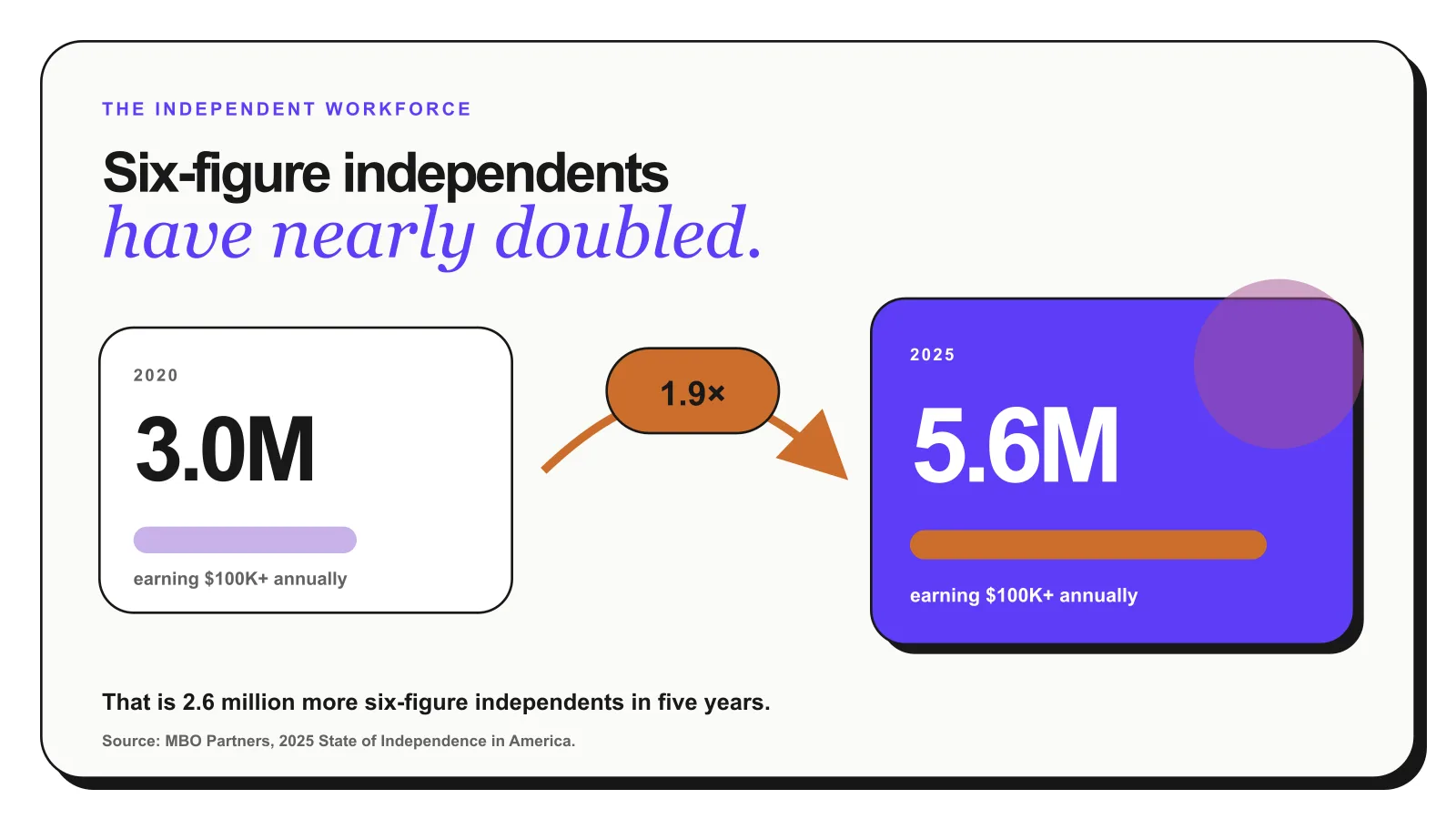
Independent work is not fringe. MBO Partners reports that the number of independent workers earning more than $100,000 annually grew from 3 million in 2020 to 5.6 million in 2025. Separately, the U.S. Census Bureau counted 30,427,808 nonemployer establishments in 2023.
Start with the problems people already bring you
You do not have to invent demand. It is usually already pointed at you, and you have stopped noticing because it feels like the job. Look for repetition:
- The thing colleagues route to you because you get it right.
- The question people ask you over coffee or in your messages.
- The problem you have solved so often that you have shortcuts nobody else has.
- The mess you were hired to clean up more than once.
Write down every instance. Do not filter yet. Repetition is the closest free signal that a real problem exists and people want it handled.
Score your options with the Sellable Offer Scorecard
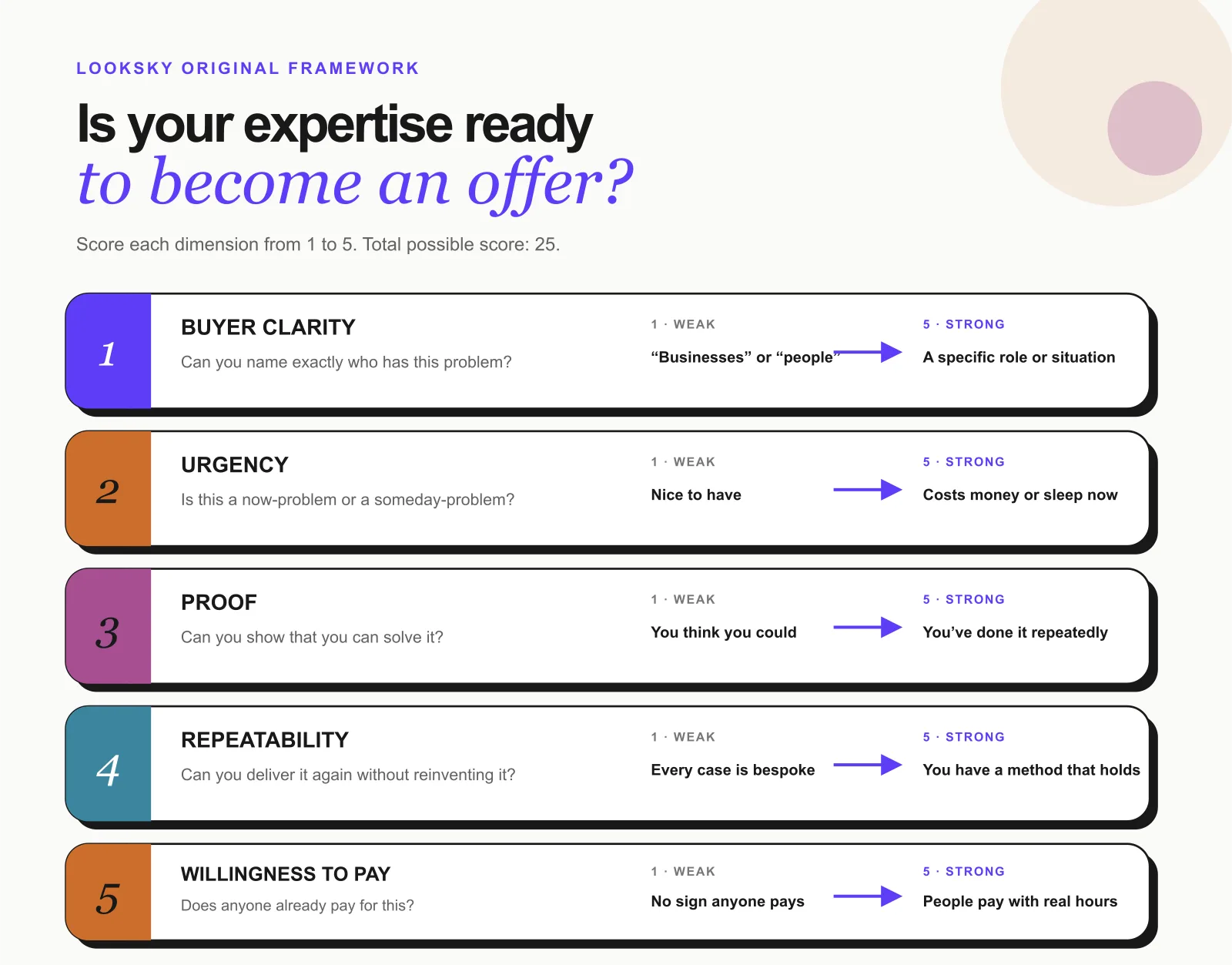
Once you have a few candidates, compare them on five dimensions: buyer clarity, urgency, proof, repeatability and willingness to pay. Score each from 1 to 5, for a total out of 25.
How to read the total
- 20 and above: pursue it now.
- 14 to 19: usually one fixable weak spot, most often buyer clarity.
- Below 14: demand probably is not there yet, however good you are.
A worked example
Imagine a senior finance operator whose colleagues repeatedly ask for help cleaning up forecasts before board meetings. “Financial modeling” is the skill. “A forecast the board can trust” is the outcome. “A board-ready operating model for Series A founders in two weeks” is the offer.
Match your offer to a format
| Format | What it is | Best when |
|---|---|---|
| Consulting | You diagnose and advise | The buyer has a team to execute |
| Fractional leadership | You run a function part-time | They need senior leadership, not a full-time hire |
| Productized service | Fixed scope, price and outcome | You have found a repeatable result |
| Coaching | Guidance toward a goal | The buyer needs to build the capability |
| Workshop | You teach a group | A team needs to level up together |
| Template or toolkit | You sell the artifact | The tool delivers value without you present |
Starting out and want revenue quickly? Consulting or a productized service usually reaches a paying customer fastest. Courses and templates work better once you already know the buyer well.
Pick one, then validate before you build
Choose the offer with the highest score and the shortest path to a first customer. If two are close, pick the one where you already know people who fit the buyer. It is a starting position, not a life sentence.
Your first week
- List every problem people brought you in the last three years.
- Turn the top three into draft offers: one outcome for one buyer.
- Score all three with the Sellable Offer Scorecard.
- Write down ten real people who fit the top offer’s buyer.
- Book two conversations and ask how they handle the problem today. Do not pitch.
Two mistakes that waste the first quarter
- Choosing what you are best at over what people pay for. Follow the demand, not the pride.
- Building before talking to buyers. A website and logo can be procrastination with good production values. Talk to buyers first.
Sam’s field note
They were not buying the suit.

I ran a custom clothing business in Boston for eleven years before I exited it. For a long time I thought the business was the clothes: the fabric, the fittings, the craft I was proud of.
But a customer would come in three weeks before his wedding, quietly terrified, needing to believe I would get it right. Someone starting a new job needed to walk in looking like they belonged. They were buying the end of a worry at a moment that mattered.
The lesson: do not lead with the skill you like best. Find the high-stakes problem your skill quietly solves.
The honest limit: this was an in-person, high-trust business. The instinct transfers; my exact playbook does not.
— Samantha Shih, co-founder of LookSky
Where LookSky fits
Everything above happens before a tool matters. You find the problem, pick the offer and get a real person to pay. No software does that judgment for you.
Then a different problem starts. A validated offer has to become something that runs: a website that explains it, content that reaches the right people, leads that get answered and follow-up that does not disappear when delivery gets busy.
Frequently asked questions
How do I know if my skill is worth paying for?
Look for money already in motion. If the buyer currently pays a consultant, buys a tool, hires an employee, or loses meaningful time or revenue because the problem remains unsolved, there may be a market. Then test your specific version with a paid pilot. Compliments show interest; a buyer accepting a clear scope and price is evidence of willingness to pay.
What is the difference between a skill and an offer?
A skill is something you can do, such as financial modeling. An outcome is the change that skill creates, such as a forecast the board trusts. An offer packages that outcome for one buyer with a defined scope, timeline, and price—for example, a board-ready operating model for a Series A founder delivered in two weeks.
Should I start with consulting or a productized service?
Start with consulting when the buyer’s problem still varies and you need room to diagnose it. Move toward a productized service after you see the same buyer, process, and outcome repeat across several engagements. Productizing too early can lock you into the wrong scope; staying fully bespoke forever makes the business harder to explain, price, and deliver consistently.
How much should I charge for my first offer?
Price the first offer against the value of the outcome, the cost of leaving the problem unsolved, and what the buyer already pays for alternatives—not only against your hourly rate. Use a fixed-scope paid pilot with a clear deliverable and timeline. The goal is not perfect pricing; it is learning whether a real buyer will pay for this result.
Do I need a website before I sell anything?
No. Begin with direct conversations and a simple written offer that states the buyer, problem, outcome, scope, timing, and price. Build the website after buyers consistently respond to the same message. At that point the site can explain a validated offer and capture demand, instead of becoming an expensive guess about what people might want.
What if I have too many skills and cannot pick one?
Turn each promising skill into a candidate offer, then score it for buyer clarity, urgency, proof, repeatability, and willingness to pay. Choose the highest-scoring option with the shortest path to a real buyer and test it for one month. You are selecting the next experiment, not deciding what you must do for the rest of your career.
How do I validate demand without a big audience?
Speak with 5 to 10 people who closely match the buyer. Ask how they handled the problem recently, what it cost, what they tried, and who controls the budget. Then offer a specific paid pilot to the strongest matches. One qualified buyer paying for the outcome is more useful validation than a large audience liking a general idea.